Healthcare
AI health is moving at machine speed. Trust still moves at human speed.
Jacqueline Tarry · 4 September 2026 · 9 min read
AI has moved into healthcare remarkably quickly.
In May 2026, the Policy Institute at King's College London reported that 15% of UK adults had used an AI chatbot for health advice instead of contacting a GP or another NHS service. The study surveyed 2,093 UK adults.
But use and trust are moving at different speeds.
When the same study asked about AI making clinical decisions, opinion was almost perfectly divided: 37% supported it and 38% opposed it. And 76% wanted AI used in patient care to be officially approved and regulated, even if that slowed its adoption.
It is an interesting tension for anyone building the next generation of private healthcare.
People can see what AI might make possible
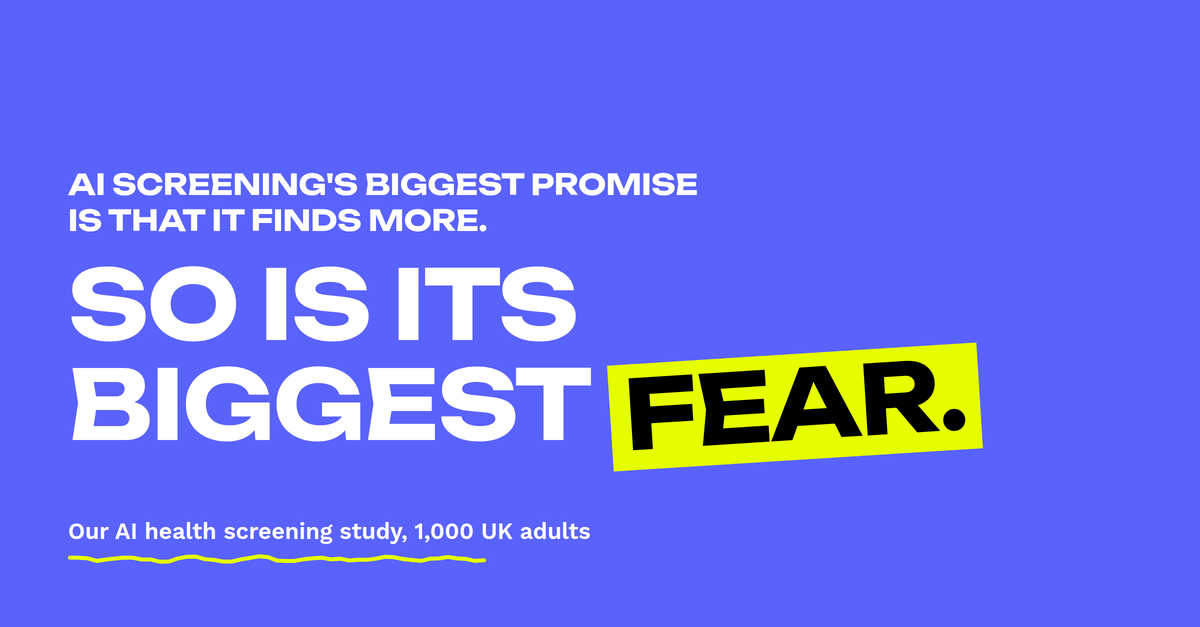
In December 2025, we surveyed a nationally representative sample of 1,000 UK adults about AI-powered private health screening.
48% of Millennials believed AI could spot early warning signs that traditional checks might miss. Among the Proactive health seekers that rose to around 58%.
56% of Millennials said they would pay more for screening that was significantly more accurate at early detection. Almost half of Gen Z and Millennials saw advanced health screening as an investment in their future.
The capability is compelling. The harder question is what makes people confident enough to act on what it finds.
The smarter the technology, the more visible the human may need to be
The strongest pattern was around trust.
71% of Boomers needed evidence that AI screening was accurate before trusting the results. Around 65% of Proactive health seekers said the same.
Around 64% of Proactive health seekers wanted a human doctor to confirm an AI result, with demand rising from 42% of Gen Z to 64% of Boomers. Around six in ten Millennials, Gen X and Boomers also said being able to share results with their GP mattered to their decision.
And our findings are echoed by much larger research.
The Health Foundation surveyed 8,000 UK adults and more than 2,000 NHS staff. When members of the public were asked to choose, 72% prioritised strong evidence that an AI tool works over getting it into use quickly. 70% prioritised a human checking AI output over receiving results faster.
Human oversight isn't reassurance wrapped around the technology. It changes people's willingness to trust it.
Finding more is both the promise and the fear
One of the core promises of advanced screening is finding things earlier.
But a major anxiety in our research was finding things that perhaps never needed to be found.
Around 55% of Millennials, Gen X and Boomers worried that AI screening could uncover minor, harmless issues and lead to unnecessary stress and further tests. Among Proactive health seekers, concern rose to around 60%.
That fear has a clinical basis. The Royal College of Radiologists warns that elective MRI screening of otherwise healthy people can uncover irregularities that turn out to be harmless, potentially causing unnecessary anxiety and treatment.
So the ability to find more is simultaneously part of the reason to buy and part of the reason to hesitate.
Which means the customer isn't only buying detection. They're buying confidence in what follows detection.
Who interprets the finding? How is its significance judged? What needs investigating? What doesn't? Where does a doctor enter the process? Those questions may matter as much as another claim about accuracy.
The industry talks about what might be wrong with your body
We asked whether living a healthy life for as long as possible mattered more than simply living longer.
Agreement rose with age: 46% of Gen Z, 53% of Millennials, 59% of Gen X and 66% of Boomers agreed.
That points to something much more human than lifespan as a number.
Staying independent. Mobile. Energetic. Capable. Protecting the ability to keep doing whatever makes life feel like yours.
The industry naturally talks about disease risk, abnormalities and what might be happening inside the body. The customer is thinking about the life happening outside it.
What will I still be able to do? How long can I keep living life on my terms?
Clinical proof matters enormously. Our research makes that clear. But the proof has to connect to something worth protecting.
People aren't buying more years. They're buying more of the life they love.
What this means for brands
Trust in AI healthcare isn't one message. It is built through evidence, medical judgement, clarity about what happens next and honesty about the limits of what the technology can tell you.
But credibility is only half the job. The other half is making all that capability matter to a human being.
AI health shows how quickly the customer's question can change.
- Can this really work?
- Becomes: Can I trust what it tells me?
- Becomes: What will knowing help me protect?
That progression matters well beyond healthcare. Customers, culture and categories keep moving. Brand Drift starts when a brand's understanding of what matters fails to move with them.
Brands drift when the question changes and they keep answering the old one.
DON'T WAIT FOR YOUR REVENUE TO TELL YOU.
Brand Drift starts earlier. Our five-minute Brand Drift scorecard looks across 20 signals to show whether your brand is Holding Strong, Drifting or In Freefall.
20 questions shaped by 25+ years of seeing how brands grow, stall and lose relevance.
Take the Brand Drift scorecard →Jacqueline Tarry
Chief Strategy Officer at Lunar Agency
Helping brands stay relevant when markets move.
Connect on LinkedIn →