
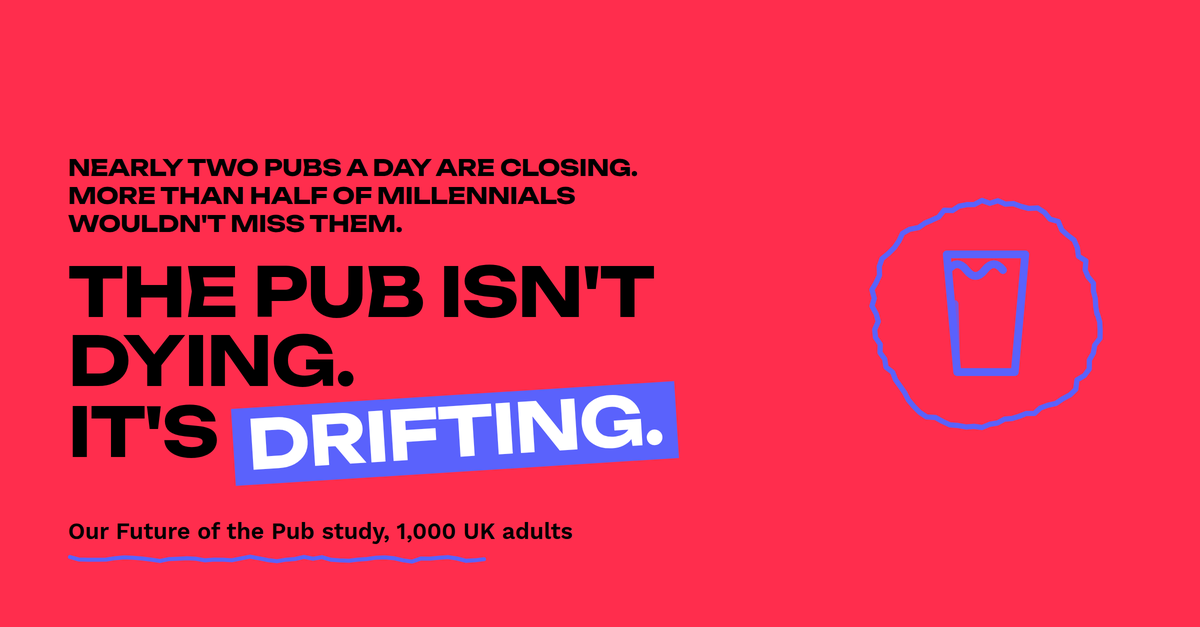
The British Beer and Pub Association counted 161 pub closures across Britain in the first three months of 2026. Nearly two every day.
That reads differently against what came before. The BBPA recorded 336 net closures across the whole of 2025, and nearly 2,200 over the five years to the end of it, with the estate falling from 46,829 pubs to 44,656. Which means the first quarter of 2026 alone accounted for close to half of everything 2025 lost, and closures ran 26% above the same period a year earlier.
NIQ's Hospitality Market Monitor adds an important stat. Britain's total number of licensed premises was broadly flat in the second quarter, at 98,564 at the end of June, but only after extraordinary churn: 1,839 venues closed between March and June while 1,794 opened. That is all licensed premises rather than pubs alone — stability on paper can hide a lot of instability underneath.
And the pressure has not eased. In NIQ and Zonal's Business Confidence Survey, fielded in July among leaders with oversight of more than 17,000 hospitality sites, 41% said footfall had declined recently, while 52% said profitability had fallen or their business was currently loss-making or unviable.
Costs explain a lot. They may not explain everything. Business rates. Wages. Energy. Beer duty. Food costs. National Insurance. All real. All capable of pushing a viable pub over the edge. But there is another question sitting underneath the economics: what if pubs are becoming harder to run at the same time as the category is becoming less essential to some of the people it needs next?
That was the question underneath a nationally representative study we ran in May 2025 with 1,000 UK adults. One answer stayed with us. 53% of Millennials agreed with the statement 'if pubs disappeared tomorrow, I wouldn't really miss them'. Gen Z came in at 46%. Gen X and Boomers at 42%. That tells us that cost is unlikely to be the only question worth asking. We call that distance Brand Drift, the gap between what a market now wants and what a brand still offers, and it opens a long way before it appears in anybody's numbers.
Disengaged does not mean unreachable
The most interesting part of the research was the contradiction. The groups showing the greatest emotional distance were also clear about what could make pubs more worth choosing.
- 62% of Millennials said live music or entertainment would make them stay longer.
- 58% of Gen Z and 56% of Millennials said they would visit more often for cultural or educational events.
- 57% of Gen Z said they were more likely to return to pubs that felt welcoming to non-drinkers.
That is not a generation saying 'we're done with pubs'. It looks much more like a demand for a different reason to come.
The sofa became a serious competitor
Our research also showed how much the competitive set has changed. 38% of Gen X and 35% of Boomers said they would rather be at home than go to the pub in the evening.
The pub is not only competing with the pub down the road. It is competing with the sofa, streaming, takeaway, gaming, friends coming round and everything else that has made staying home easier and better. If leaving home costs considerably more than staying there, the experience has to earn the difference.
Value moves behaviour
Price matters. But price cannot do all the work. 62% of Gen X and 55% of Millennials said they were less likely to visit a pub without promotions. Operators would be foolish to ignore that. But if price becomes the main reason to visit, another venue can usually offer a cheaper reason tomorrow. Promotions can stimulate demand. They cannot, on their own, make the pub matter.
What if younger generations are not abandoning the pub, but waiting for it to become something worth inheriting? If the competition is staying in, price cannot be the argument, because home will always be cheaper. The only things that reliably beat the sofa are the ones you cannot get on it: other people, live programming, and a space that feels built for you. That makes this a product question rather than a promotions one.
The pub may not need saving from change
There is a temptation whenever pubs close to talk about preserving them. Preserving the local. Protecting heritage. Saving an institution. All worthwhile. But preservation cannot be the whole strategy. Pubs became institutions because they adapted to the lives happening around them.
The more interesting challenge now is not how to preserve the pub we inherited. It is what the next version should become.
KEEP THE SPIRIT. RETHINK THE FORMAT.
WHAT SHOULD WE ASK NEXT?
Our 2025 study raised as many questions as it answered. With the category declining even faster, we think it is time to revisit them. If you run a pub, operate across hospitality or work anywhere in the sector, we'd love your input.
- What do you wish you knew about your customers?
- What behaviour are you struggling to understand?
- What assumption about the future of the pub would you like us to put to the test?
Send us the questions you think the sector needs answered. They could help shape the next Future of the Pub study. Get in touch: hello@lunar.agency
Send us the questions you think the sector needs answered.
Get in touch →Jacqueline Tarry
Chief Strategy Officer at Lunar Agency
Helping brands stay relevant when markets move.
Connect on LinkedIn →